
Background
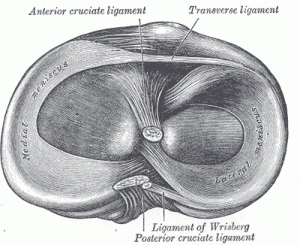
The meniscus is a specialized cartilage found in the knee that lies between the femur and the tibia. The primary purpose of the meniscus is to decrease the contact pressure between the femur and the tibia. The secondary purpose of the meniscus is to contribute to the stability of the knee. Determining if a patient has a meniscus tear is based on the physical examination and imaging – typically a knee MRI.
The meniscus has a unique anatomy with an overall shape similar to the letter C with robust collagen fibers running the length of the meniscus. These fibers are strongly anchored both anteriorly and posteriorly and these anchor points otherwise known as roots are critical to the meniscus function. In cross section it has a triangular shape in cross section with the blood supply coming from the peripheral edge. As the meniscus tapers centrally it has essentially blood supply
Injuries
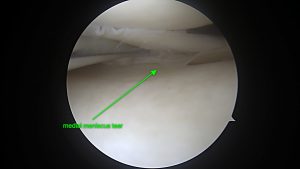
Meniscus injuries are very common and arthroscopic partial meniscus resection is the most common surgery performed by orthopedic surgeons each year. The meniscus can be injured by an acute traumatic event or by a degenerative process. In the younger population, meniscus injuries are related to large shifts in the knee such as when a ligament is torn. In the elderly population, the meniscus tissue is less pliable and subject to tearing with more minor trauma. If a knee becomes arthritic the irregularity of the cartilage or exposed bone can pinch/grind the meniscus tissue and cause tearing.
There is a great degree of variability in the type of meniscus tears. The basic tear patterns are horizontal tears, longitudinal tears, radial tears and root tears. How to approach these tears surgically depends upon the size of the tear, the blood supply to the tear, overall health of the joint, and the age of the patient.
Treatment
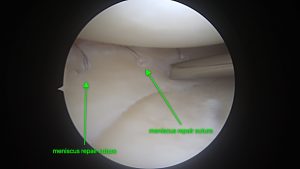
Treatment options include injection therapy with either biologics or steroid, partial resection, repair of the meniscus and in select cases meniscus transplant. A partial resection of the meniscus is the most common orthopedic procedure done each year. A partial resection means that the torn portions of the meniscus are removed and at times this is the best option for the knee. However, the meniscus has a very important function of distributing the weight of the body across the knee so the cartilage does not experience as much pressure. In my hands, I am aggressive about repairing the meniscus when I can to preserve the long-term health of the knee. When a meniscus is unsalvageable and the underlying knee cartilage is in good condition, a meniscus transplantation can be performed – restoring more normal knee function.